Fyre, formerly de Jong Explorer, is a cross-platform tool for producing artwork based on histograms of iterated chaotic functions. It implements the Peter de Jong map in a fixed function pipeline through either a GTK GUI frontend, or a command line facility for easier rendering of high-resolution, high quality images. The program was renamed from de Jong Explorer to Fyre simply because 'It wasn't taken yet' and so that in the future, it could support more functions than just the standard Peter de Jong map. Fyre features a sidebar on the left to which the user can input the required variables and on the right is displayed the result of the equation. == Extra features == Additional image manipulation tools such as Gaussian blurs and Gamma controls are included in the program. The advantage to using them directly within Fyre is that the image accuracy and quality do not decline. Fyre features animation capabilities so that a user can link together several maps and create uncompressed AVIs from them. However, the uncompressed animation files are very large and so should be compressed with a separate tool, such as mencoder. == Peter de Jong Map == For most values of a,b,c and d the point (x,y) moves chaotically. The resulting image is a map of the probability that the point lies within the area represented by each pixel. Therefore, the longer that the user lets Fyre render for, the larger the probability map becomes and the more accurate the resulting image.
Outline of deep learning
The following outline is provided as an overview of, and topical guide to, deep learning: Deep learning is a subfield of machine learning and artificial intelligence based on artificial neural networks with multiple processing layers. It emphasizes representation learning and is widely used in areas such as computer vision, natural language processing, speech recognition, recommender systems, robotics, and generative artificial intelligence. == Ways to categorize deep learning == A field of study A branch of artificial intelligence A subfield of machine learning A subfield of computer science A form of representation learning A class of methods based on artificial neural networks An approach used in computational statistics == History == === Precursors === Cybernetics Perceptron Connectionism Neocognitron Backpropagation === Milestones === LeNet Long short-term memory Deep belief network AlexNet Sequence to sequence learning Generative adversarial network Residual neural network Transformer BERT Generative pre-trained transformer Diffusion model === Related histories === History of artificial intelligence History of machine learning Timeline of machine learning == Core concepts == == Learning settings == Supervised learning Unsupervised learning Self-supervised learning Semi-supervised learning Reinforcement learning Transfer learning Multitask learning Multimodal learning Online machine learning Continual learning == Common tasks == Image classification Object detection Image segmentation Automatic speech recognition Neural machine translation Question answering Automatic summarization Text-to-image model Protein structure prediction == Architectures == === Feedforward and convolutional architectures === Feedforward neural network Multilayer perceptron Convolutional neural network Radial basis function network Residual neural network U-Net === Recurrent and sequence architectures === Recurrent neural network Long short-term memory Gated recurrent unit Sequence to sequence learning Recursive neural network === Representation-learning architectures === Autoencoder Denoising autoencoder Sparse autoencoder Variational autoencoder Restricted Boltzmann machine Deep belief network === Attention and transformer architectures === Attention (machine learning) Transformer BERT Generative pre-trained transformer Vision transformer === Generative and probabilistic architectures === Autoregressive model Diffusion model Energy-based model Generative adversarial network Mixture of experts === Graph and memory architectures === Graph neural network Graph convolutional network Siamese network Neural Turing machine Memory network Echo state network Capsule neural network == Neural network components and techniques == Artificial neuron Activation function Rectified linear unit Sigmoid function Softmax function Embedding Convolution Pooling layer Attention Batch normalization Layer normalization Residual connections == Training and optimization == Backpropagation Gradient descent Stochastic gradient descent Adam optimization Learning rate Loss function Cross-entropy Mean squared error Regularization Dropout Early stopping Batch normalization Data augmentation Transfer learning Knowledge distillation Ensemble learning Curriculum learning == Datasets and benchmarks == CIFAR-10 ImageNet MNIST database Common Objects in Context (COCO) General Language Understanding Evaluation (GLUE) benchmark LibriSpeech SQuAD == Applications == === Computer vision === Computer vision Facial recognition system Image classification Image segmentation Medical imaging Object detection Optical character recognition === Natural language processing === Automatic summarization Chatbot Information retrieval Large language model Natural language processing Neural machine translation Question answering Sentiment analysis === Speech and audio === Automatic speech recognition Music information retrieval Speaker recognition Speech synthesis === Science and medicine === Bioinformatics Computational biology Drug discovery Medical diagnosis Protein structure prediction === Robotics and control === Autonomous car Computer game bot Control theory Robotics === Recommendation, search, and forecasting === Anomaly detection Forecasting Fraud detection Recommender system Search engine === Generative artificial intelligence === Deepfake Generative artificial intelligence Large language model Speech synthesis Text-to-image model === Computer graphics and video games === Deep Learning Anti-Aliasing (DLAA) Deep Learning Super Sampling (DLSS) == Hardware == AMD Instinct AMD XDNA Application-specific integrated circuit Deep learning processor, Neural processing unit (NPU), or Neural Engine Field-programmable gate array General-purpose computing on graphics processing units (GPGPU) Graphics processing unit NVIDIA Deep Learning Accelerator (NVDLA) Tensor processing unit Vision processing unit Wafer-scale integration === Supporting software platforms === CUDA Metal ROCm == Software == === Open-source frameworks and libraries === === Neural network software === EDLUT Emergent Encog JOONE Neuroph NeuroSolutions OpenNN Peltarion Synapse SNNS === Platforms, tools, and deployment === Amazon SageMaker Google Colab Hugging Face Kaggle Kubeflow MLflow ONNX OpenVINO TensorFlow Hub == Algorithms for deep learning and neural networks == Backpropagation Conjugate gradient method Generalized Hebbian algorithm Gradient descent Levenberg–Marquardt algorithm Perceptron Quasi-Newton method Wake-sleep algorithm == Methods and related topics == === Representation and metric learning === Contrastive learning Embedding Feature learning Manifold learning Metric learning === Generative modeling === Autoregressive model Diffusion model Generative adversarial network Generative model Variational inference === Efficient and scalable deep learning === Knowledge distillation Low-rank approximation Mixture of experts Quantization Sparsity === Reliability, safety, and interpretability === Adversarial machine learning AI alignment Algorithmic bias Catastrophic forgetting Differential privacy Explainable artificial intelligence Federated learning Hallucination (artificial intelligence) == Conferences and workshops == Annual Meeting of the Association for Computational Linguistics Conference on Computer Vision and Pattern Recognition Conference on Neural Information Processing Systems International Conference on Computer Vision International Conference on Learning Representations International Conference on Machine Learning == Organizations == === Research laboratories and institutions === Allen Institute for AI Alberta Machine Intelligence Institute European Laboratory for Learning and Intelligent Systems Google DeepMind Meta AI Mila Microsoft Research Vector Institute === Companies === Anthropic Cerebras Cohere DeepSeek Mistral AI OpenAI Stability AI xAI == Publications == === Books === Deep Learning – Ian Goodfellow and Yoshua Bengio Neural Networks and Deep Learning – Michael Nielsen Perceptrons – Marvin Minsky and Seymour Papert === Journals === IEEE Transactions on Neural Networks and Learning Systems Neural Networks Neural Computation == Influential persons ==
Information security
Information security is the practice of protecting information by mitigating information risks. It is part of information risk management. It typically involves preventing or reducing the probability of unauthorized or inappropriate access to data or the unlawful use, disclosure, disruption, deletion, corruption, modification, inspection, recording, or devaluation of information. It also involves actions intended to reduce the adverse impacts of such incidents. Protected information may take any form, e.g., electronic or physical, tangible (e.g., paperwork), or intangible (e.g., knowledge). Information security's primary focus is the balanced protection of data confidentiality, integrity, and availability (known as the CIA triad, unrelated to the US government organization) while maintaining a focus on efficient policy implementation, all without hampering organization productivity. This is largely achieved through a structured risk management process. To standardize this discipline, academics and professionals collaborate to offer guidance, policies, and industry standards on passwords, antivirus software, firewalls, encryption software, legal liability, security awareness and training, and so forth. This standardization may be further driven by a wide variety of laws and regulations that affect how data is accessed, processed, stored, transferred, and destroyed. While paper-based business operations are still prevalent, requiring their own set of information security practices, enterprise digital initiatives are increasingly being emphasized, with information assurance now typically being dealt with by information technology (IT) security specialists. These specialists apply information security to technology (most often some form of computer system). IT security specialists are almost always found in any major enterprise/establishment due to the nature and value of the data within larger businesses. They are responsible for keeping all of the technology within the company secure from malicious attacks that often attempt to acquire critical private information or gain control of the internal systems. There are many specialist roles in Information Security including securing networks and allied infrastructure, securing applications and databases, security testing, information systems auditing, business continuity planning, electronic record discovery, and digital forensics. == Standards == Information security standards are guidelines generally outlined in published materials that aim to protect a user's or an organization's cyber environment from threats. This environment includes the users themselves, hardware such as devices and networks, software such as applications or services, and any information in storage or transit. These standards comprise security concepts, technologies, and guidelines to deal with an adverse event. They may also include assessment criteria and certification for organizations implementing a minimum level of security. These standards are developed by various international and national bodies to prevent or mitigate cyber-attacks, ensure consistency among developers, and establish a minimum standard in industries susceptible to an attack. The ISO/IEC 27000 family, published by the International Organization for Standardization (ISO) and the International Electrotechnical Commission (IEC), provides information about the guidelines and requirements for an Information Security Management System (ISMS). The Common Criteria (ISO/IEC 15408) provides guidelines on evaluating and certifying the security of a system. The IEC 62443 establishes security standards for automation and control systems. Similarly, the ISO/SAE 21434, ETSI EN 303 645, and EN 18031 provide standards for road vehicles, the Internet of Things, and radio-based systems respectively. The NIST Cybersecurity Framework (NIST CSF) is a set of guidelines developed by the U.S. National Institute of Standards and Technology to help organizations with risk management. NIST also publishes various Federal Information Processing Standards (FIPS) and Special Publications. The United Kingdom has introduced Cyber Essentials, which is a certification scheme to protect organizations against common security threats. The Australian Cyber Security Centre publishes the Essential Eight mitigation strategies. The Payment Card Industry Data Security Standard (PCI DSS) regulates handling of cardholder data in order to reduce credit card fraud. UL has published standards related to specific industries such as UL 2900-2-3 for security and life safety signaling systems and UL-2900-2-1 for healthcare and wellness systems. == Threats == Information security threats come in many different forms. Some of the most common threats today are software attacks, theft of intellectual property, theft of identity, theft of equipment or information, sabotage, and information extortion. Viruses, worms, phishing attacks, and Trojan horses are a few common examples of software attacks. The theft of intellectual property has also been an extensive issue for many businesses. Identity theft is the attempt to act as someone else usually to obtain that person's personal information or to take advantage of their access to vital information through social engineering. Sabotage usually consists of the destruction of an organization's website in an attempt to cause loss of confidence on the part of its customers. Information extortion consists of theft of a company's property or information as an attempt to receive a payment in exchange for returning the information or property back to its owner, as with ransomware. One of the most functional precautions against these attacks is to conduct periodical user awareness. Governments, military, corporations, financial institutions, hospitals, non-profit organizations, and private businesses amass a great deal of confidential information about their employees, customers, products, research, and financial status. Should confidential information about a business's customers or finances or new product line fall into the hands of a competitor or hacker, a business and its customers could suffer widespread, irreparable financial loss, as well as damage to the company's reputation. From a business perspective, information security must be balanced against cost; the Gordon-Loeb Model provides a mathematical economic approach for addressing this concern. For the individual, information security has a significant effect on privacy, which is viewed very differently in various cultures. == History == Since the early days of communication, diplomats and military commanders understood that it was necessary to provide some mechanism to protect the confidentiality of correspondence and to have some means of detecting tampering. Julius Caesar is credited with the invention of the Caesar cipher c. 50 B.C., which was created in order to prevent his secret messages from being read should a message fall into the wrong hands. However, for the most part protection was achieved through the application of procedural handling controls. Sensitive information was marked up to indicate that it should be protected and transported by trusted persons, guarded and stored in a secure environment or strong box. As postal services expanded, governments created official organizations to intercept, decipher, read, and reseal letters (e.g., the U.K.'s Secret Office, founded in 1653). In the mid-nineteenth century more complex classification systems were developed to allow governments to manage their information according to the degree of sensitivity. For example, the British Government codified this, to some extent, with the publication of the Official Secrets Act in 1889. Section 1 of the law concerned espionage and unlawful disclosures of information, while Section 2 dealt with breaches of official trust. A public interest defense was soon added to defend disclosures in the interest of the state. A similar law was passed in India in 1889, The Indian Official Secrets Act, which was associated with the British colonial era and used to crack down on newspapers that opposed the Raj's policies. A newer version was passed in 1923 that extended to all matters of confidential or secret information for governance. By the time of the First World War, multi-tier classification systems were used to communicate information to and from various fronts, which encouraged greater use of code making and breaking sections in diplomatic and military headquarters. Encoding became more sophisticated between the wars as machines were employed to scramble and unscramble information. The establishment of computer security inaugurated the history of information security. The need for such appeared during World War II. The volume of information shared by the Allied countries during the Second World War necessitated formal alignment of classification systems and procedural controls. An arcane range of markings evol
Comparison of OLAP servers
The following tables compare general and technical information for a number of online analytical processing (OLAP) servers. Please see the individual products articles for further information. == General information == == Data storage modes == == APIs and query languages == APIs and query languages OLAP servers support. == OLAP distinctive features == A list of OLAP features that are not supported by all vendors. All vendors support features such as parent-child, multilevel hierarchy, drilldown. == System limits == == Security == == Operating systems == The OLAP servers can run on the following operating systems: Note (1):The server availability depends on Java Virtual Machine not on the operating system == Support information ==
Social search
Social search is a behavior of retrieving and searching on a social searching engine that mainly searches user-generated content such as news, videos and images related search queries on social media like Facebook, LinkedIn, Twitter, Instagram and Flickr. It is an enhanced version of web search that combines traditional algorithms. The idea behind social search is that instead of ranking search results purely based on semantic relevance between a query and the results, a social search system also takes into account social relationships between the results and the searcher. The social relationships could be in various forms. For example, in LinkedIn people search engine, the social relationships include social connections between searcher and each result, whether or not they are in the same industries, work for the same companies, belong the same social groups, and go the same schools, etc. Social search may not be demonstrably better than algorithm-driven search. In the algorithmic ranking model that search engines used in the past, relevance of a site is determined after analyzing the text and content on the page and link structure of the document. In contrast, search results with social search highlight content that was created or touched by other users who are in the Social Graph of the person conducting a search. It is a personalized search technology with online community filtering to produce highly personalized results. Social search takes many forms, ranging from simple shared bookmarks or tagging of content with descriptive labels to more sophisticated approaches that combine human intelligence with computer algorithms. Depending on the feature-set of a particular search engine, these results may then be saved and added to community search results, further improving the relevance of results for future searches of that keyword. The principle behind social search is that human network oriented results would be more meaningful and relevant for the user, instead of computer algorithms deciding the results for specific queries. == Research and implementations == Over the years, there have been different studies, researches and some implementations of Social Search. In 2008, there were a few startup companies that focused on ranking search results according to one's social graph on social networks. Companies in the social search space include Sproose, Mahalo, Jumper 2.0, Scour, Wink, Eurekster, and Delver. Former efforts include Wikia Search. In 2008, a story on TechCrunch showed Google potentially adding in a voting mechanism to search results similar to Digg's methodology. This suggests growing interest in how social groups can influence and potentially enhance the ability of algorithms to find meaningful data for end users. There are also other services like Sentiment that turn search personal by searching within the users' social circles. In 2009, a startup project called HeyStaks (www.heystaks.com) developed a web browser plugin "HayStaks". HeyStaks applies social search through collaboration in web search as a way that leads to better search results. The main motivation for HeyStaks to work on this idea is to provide the user with features that search engines didn't provide at that time. For instance, different searches have indicated that about 70% of the time when user search for something, a friend or a coworker have found it already. Also, studies have shown that approximately, 30% of people who use online search, search for something that they have found before. The startup believe that they help avoid these kind of issues by providing a shared and rich search experience through a list of recommendations that get generated based on search results. In October 2009, Google rolled out its "Social Search"; after a time in beta, the feature was expanded to multiple languages in May 2011. Before the expansion however in 2010 Bing and Google were already taking into account re-tweets and Likes when providing search results. However, after a search deal with Twitter ended without renewal, Google began to retool its Social Search. In January 2012, Google released "Search plus Your World", a further development of Social Search. The feature, which is integrated into Google's regular search as an opt-out feature, pulls references to results from Google+ profiles. The goal was to deliver better, more relevant and personalized search results with this integration. This integration however had some problems in which Google+ still is not wildly adopted or has much usage among many users. Later on, Google was criticized by Twitter for the perceived potential impact of "Search plus Your World" upon web publishers, describing the feature's release to the public as a "bad day for the web", while Google replied that Twitter refused to allow deep search crawling by Google of Twitter's content. By Google integrating Google+, the company was encouraging users to switch to Google's social networking site in order to improve search results. One famous example occurred when Google showed a link to Mark Zuckerberg's dormant Google+ account rather than the active Facebook profile. In November 2014 these accusations started to die down because Google's Knowledge Graph started to finally show links to Facebook, Twitter, and other social media sites. In December 2008, Twitter had re-introduced their people search feature. While the interface had since changed significantly, it allows you to search either full names or usernames in a straight-forward search engine. In January 2013, Facebook announced a new search engine called Graph Search still in the beta stages. The goal was to allow users to prioritize results that were popular with their social circle over the general internet. Facebook's Graph search utilized Facebook's user generated content to target users. Although there have been different researches and studies in social search, social media networks have not vested enough interest in working with search engines. LinkedIn for example has taken steps to improve its own individual search functions in order to stray users from external search engines. Even Microsoft started working with Twitter in order to integrate some tweets into Bing's search results in November 2013. Yet Twitter has its own search engine which points out how much value their data has and why they would like to keep it in house. In the end though social search will never be truly comprehensive of the subjects that matter to people unless users opt to be completely public with their information. == Social discovery == Social discovery is the use of social preferences and personal information to predict what content will be desirable to the user. Technology is used to discover new people and sometimes new experiences shopping, meeting friends or even traveling. The discovery of new people is often in real-time, enabled by mobile apps. However, social discovery is not limited to meeting people in real-time, it also leads to sales and revenue for companies via social media. An example of retail would be the addition of social sharing with music, through the iTunes music store. There is a social component to discovering new music Social discovery is at the basis of Facebook's profitability, generating ad revenue by targeting the ads to users using the social connections to enhance the commercial appeal. == Social search engines == A social search engine in an aspect can be thought of as a search engine that provides an answer for a question from another answer by identifying a person in the answer. That can happen by retrieving a user submitted query and determining that the query is related to the question; and provides an answer, including the link to the resource, as part of search results that are responsive to the query. Few social search engines depend only on online communities. Depending on the feature-set of a particular search engine, these results may then be saved and added to community search results, further improving the relevance of results for future searches of that keyword. Social search engines are considered a part of Web 2.0 because they use the collective filtering of online communities to elevate particularly interesting or relevant content using tagging. These descriptive tags add to the meta data embedded in Web pages, theoretically improving the results for particular keywords over time. A user will generally see suggested tags for a particular search term, indicating tags that have previously been added. An implementation of a social search engine is Aardvark. Aardvark is a social search engine that is based on the "village paradigm" which is about connecting the user who has a question with friends or friends of friends whom can answer his or her question. In Aadvark, a user ask a question in different ways that mostly involves online ways such as instant messaging, email, web input or other non-online ways such as text message or voice. The Aar
Anthrobotics
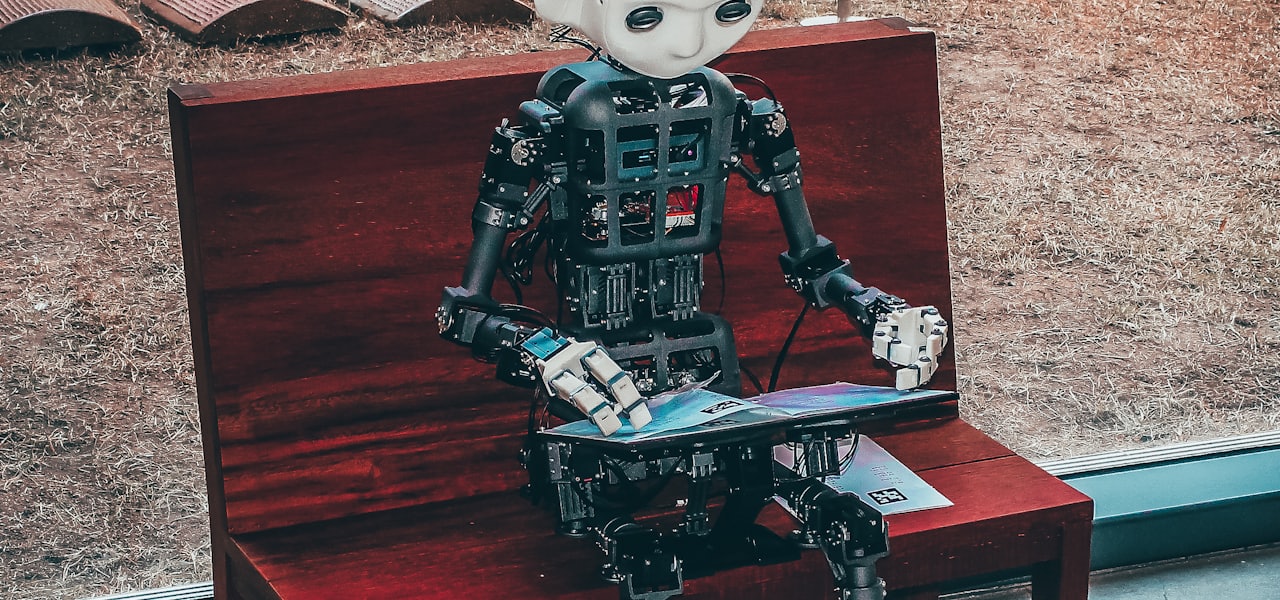
Anthrobotics is the science of developing and studying robots that are either entirely or in some way human-like. The term anthrobotics was originally coined by Mark Rosheim in a paper entitled "Design of An Omnidirectional Arm" presented at the IEEE International Conference on Robotics and Automation, May 13–18, 1990, pp. 2162–2167. Rosheim says he derived the term from "...Anthropomorphic and Robotics to distinguish the new generation of dexterous robots from its simple industrial robot forebears." The word gained wider recognition as a result of its use in the title of Rosheim's subsequent book Robot Evolution: The Development of Anthrobotics, which focussed on facsimiles of human physical and psychological skills and attributes. However, a wider definition of the term anthrobotics has been proposed, in which the meaning is derived from anthropology rather than anthropomorphic. This usage includes robots that respond to input in a human-like fashion, rather than simply mimicking human actions, thus theoretically being able to respond more flexibly or to adapt to unforeseen circumstances. This expanded definition also encompasses robots that are situated in social environments with the ability to respond to those environments appropriately, such as insect robots, robotic pets, and the like. Anthrobotics is now taught at some universities, encouraging students not only to design and build robots for environments beyond current industrial applications, but also to speculate on the future of robotics that are embedded in the world at large, as mobile phones and computers are today. In 2016 philosopher Luis de Miranda created the Anthrobotics Cluster at the University of Edinburgh "a platform of cross-disciplinary research that seeks to investigate some of the biggest questions that will need to be answered" on the relationship between humans, robots and intelligent systems and "a think tank on the social spread of robotics, and also how automation is part of the definition of what humans have always been". to explore the symbiotic relationship between humans and automated protocols.
BREACH
BREACH (a backronym: Browser Reconnaissance and Exfiltration via Adaptive Compression of Hypertext) is a security vulnerability against HTTPS when using HTTP compression. BREACH is built based on the CRIME security exploit. BREACH was announced at the August 2013 Black Hat USA conference by security researchers Angelo Prado, Neal Harris and Yoel Gluck. == Details == While the CRIME attack was presented as a general attack that could work effectively against a large number of protocols, only exploits against SPDY request compression and TLS compression were demonstrated and largely mitigated in browsers and servers. The CRIME exploits against HTTP compression has not been mitigated at all, even though the authors of CRIME have warned that this vulnerability might be even more widespread than SPDY and TLS compression combined. BREACH is an instance of the CRIME attack against HTTP compression—the use of gzip or DEFLATE data compression algorithms via the content-encoding option within HTTP by many web browsers and servers. Given this compression oracle, the rest of the BREACH attack follows the same general lines as the CRIME exploit, by performing an initial blind brute-force search to guess a few bytes, followed by divide-and-conquer search to expand a correct guess to an arbitrarily large amount of content. == Mitigation == BREACH exploits the compression in the underlying HTTP protocol. Therefore, turning off TLS compression makes no difference to BREACH, which can still perform a chosen-plaintext attack against the HTTP payload. As a result, clients and servers are either forced to disable HTTP compression completely (thus reducing performance), or to adopt workarounds to try to foil BREACH in individual attack scenarios, such as using cross-site request forgery (CSRF) protection. Another suggested approach is to disable HTTP compression whenever the referrer header indicates a cross-site request, or when the header is not present. This approach allows effective mitigation of the attack without losing functionality, only incurring a performance penalty on affected requests. Another approach is to add padding at the TLS, HTTP header, or payload level. Around 2013–2014, there was an IETF draft proposal for a TLS extension for length-hiding padding that, in theory, could be used as a mitigation against this attack. It allows the actual length of the TLS payload to be disguised by the insertion of padding to round it up to a fixed set of lengths, or to randomize the external length, thereby decreasing the likelihood of detecting small changes in compression ratio that is the basis for the BREACH attack. However, this draft has since expired without further action. A very effective mitigation is HTB (Heal-the-BREACH) that adds random-sized padding to compressed data, providing some variance in the size of the output contents. This randomness delays BREACH from guessing the correct characters in the secret token by a factor of 500 (10-byte max) to 500,000 (100-byte max). HTB protects all websites and pages in the server with minimal CPU usage and minimal bandwidth increase.